
Reference-guided anime character tool
Consistent Anime Character AI for Recognizable Manga Heroes
When panel three gives your hero a new face, upload one clear reference and rebuild the scene with stronger anchors.
Live generator. The standard generator uses one reference image and one prompt per run. Results can vary, so review facial details, hair, accessories, and costume continuity before moving to the next panel.
Experience consistent character generation
Preview mode is enabled. Sign in to upload a reference image and start generating your character.
Reference Image (Required)*
AI-generated or stylized characters work best. Real people, celebrities, logos, watermarks, or sensitive content may be blocked by safety checks; failed tasks are automatically refunded.
Supports PNG, JPG, WebP up to 20MB
* Reference image is required for generation
Character Description
Usage info
🎨 Free trial
• Your first image is free (most regions)
• Standard resolution (1024×1024)
• Multiple poses and styles
• Reference image required
Sign in to upload a reference image and start using
Generation Settings
Enhanced model with better quality and consistency (1 image per request)
1KQuick drafts for trying ideas.
Image Preview
Select or generate to preview
History (0)
No history
Generated images will appear here
The continuity problem
A strong first panel is useless if the hero drifts by the third
Anime and manga readers learn a character through a few visual anchors: fringe shape, eye color, scarf, uniform seams, and line weight. General generation can treat each prompt as a fresh casting call, so a small scene change creates a different performer.
Angles rewrite the face
A front view may look right, then a low angle or profile quietly changes the nose, eye spacing, jaw, or apparent age. That makes a sequential panel feel like a continuity error rather than a deliberate camera move.
Costumes collect random edits
Jacket colors shift, signature accessories disappear, and hair highlights move from one side to the other. These details look minor in isolation but become obvious when panels sit together on one page.
Style can drift with the scene
A quiet cafe prompt may produce soft shojo rendering while an action prompt becomes heavily shaded shonen art. Without stable style language, the sequence loses its shared visual world.
A more controlled workflow
Keep the identity block stable and let the scene block change
This consistent anime character AI starts from a reference instead of asking text alone to remember your hero. The prompt separates traits that must stay recognizable from panel details allowed to move.
Anchor the recognizable design
Use a clean reference with an unobstructed face, readable hair silhouette, and visible signature clothing. A finished character sheet crop or polished AI concept can work better than a crowded action frame.
Repeat a compact identity block
Keep the same age range, hair shape, eye color, defining accessory, outfit palette, and art treatment in every prompt. Repetition is useful here because those words are the continuity contract.
Change one scene block at a time
Swap pose, camera angle, location, expression, or lighting while leaving the identity block untouched. Smaller changes make it easier to see which instruction caused drift and which version is worth continuing.
Scenario board
One heroine, four readable moments
A useful manga generator for consistent characters should support contrast, not four near-duplicate portraits. The goal is a hero who remains recognizable on a rooftop, in a cafe, under rain, and at a station while pose, crop, mood, and light all change.
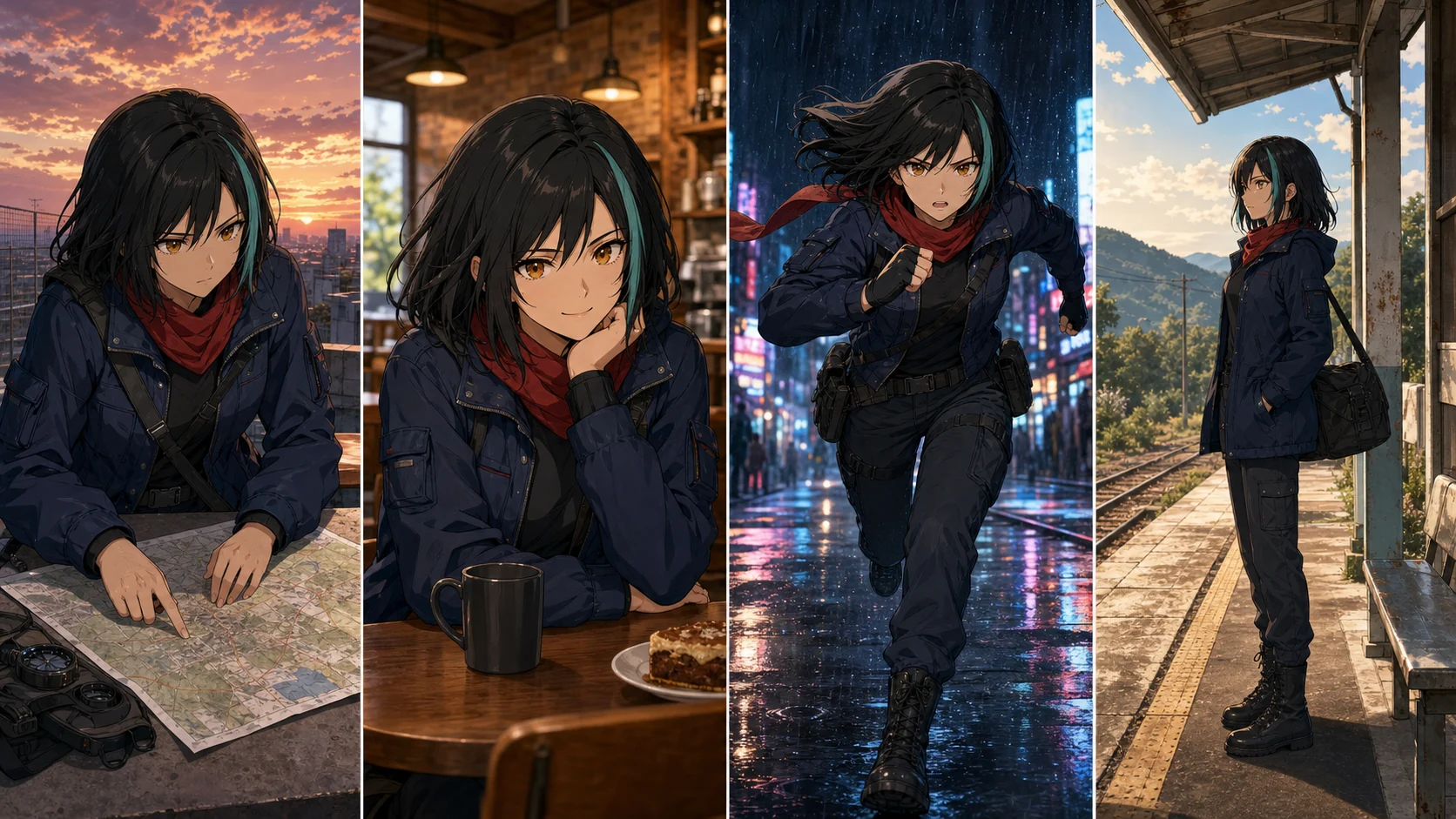
Quiet establishing panel
Use a medium shot and simple lighting first. It gives you a dependable baseline for the face, fringe, scarf shape, and jacket colors.
Expression close-up
Change the emotion while repeating the same eye color, hair streak position, age, and line-art description. Compare the jaw and eye spacing with the baseline.
Action or unusual angle
Treat dynamic perspective as a harder test. Keep the outfit description concise, state the camera angle clearly, and regenerate only the frame that drifts.
Lighting transition
Move from daylight to rain or neon without letting color grading repaint the costume. Name the local colors before describing the environmental light.
How it works
Build the next manga panel in four practical moves
You do not need to train a LoRA or prepare a large dataset for this workflow. Start with one useful reference, make one generation, then use visual review to decide whether the frame belongs in the sequence.
- 01
Upload the clearest reference
Choose one image where the hero is easy to read. Avoid tiny faces, heavy occlusion, motion blur, watermarks, and unrelated background characters.
- 02
Write the fixed character anchors
Describe hair, eyes, age, face impression, signature accessory, clothing palette, and anime treatment. Keep this short block available for reuse.
- 03
Add the new panel direction
Specify framing, pose, expression, location, time of day, and only the action that matters. A focused panel prompt is easier to diagnose than a paragraph of competing events.
- 04
Generate, compare, and keep the best frame
Check the face, hair side, hands, accessory placement, and costume before download. If one detail fails, simplify the scene or clarify that anchor for the next run.
Who it helps
Useful when a character must survive more than one illustration
The tool is strongest as an iteration aid for creators who already know what should stay fixed. It can shorten early visual development, but final sequential art still benefits from selection, paint-over, lettering, and a human continuity pass.
For solo artists and small comic teams
Manga and webcomic planning
Explore camera choices, emotional beats, and scene transitions before committing to finished pages. Use outputs as references, thumbnails, or editable foundations according to your workflow.
For writers and indie game teams
Visual novel scene concepts
Test a protagonist in bedrooms, schools, streets, and dramatic close-ups while maintaining the design language established by the original sprite or concept.
For directors and pitch creators
Anime storyboards
Make readable beat boards where collaborators can follow who is on screen. Consistency matters more than polish when the board is communicating pacing and coverage.
For illustrators and fandom creators
Character-led social series
Develop seasonal scenes, reaction posts, and short visual narratives around one recognizable original character instead of rebuilding the design from memory each time.
Prompt guide
Write one reusable identity sentence
A useful prompt names the fixed design before the changing shot. Avoid long lists of synonyms. Concrete visual nouns such as red scarf, blunt bob, amber eyes, and navy jacket are easier to compare across images than abstract phrases such as beautiful or cool.
Example identity plus scene prompt
Same adult anime heroine, short black bob with one teal streak on her left side, amber eyes, red scarf, navy cropped jacket. Three-quarter medium shot on a rainy train platform at night, alert expression, clean manga line art, restrained cel shading, blue reflections.
- Keep the character clause identical across related panel prompts.
- State left or right for asymmetric hair, scars, earrings, and accessories.
- Use the same art-style phrase across the sequence instead of naming many styles.
- Save accepted prompts beside the images so later revisions have a clear baseline.
Reference guidance reduces drift but does not create a mathematical identity lock. Hands, small accessories, text, extreme foreshortening, and crowded scenes may still need another run or manual correction.
Consistent anime character AI questions
These answers describe the current reference-based generator and a realistic production workflow.
How do I keep the same anime character across manga panels?
Use the same clear reference image and repeat a short identity block in every prompt. Keep hair shape, eye color, age, defining accessory, clothing palette, and line-art treatment stable. Change only the panel-specific pose, expression, camera, and environment, then visually compare each result before adding it to the sequence.
Do I need to train a LoRA for an original anime character?
No. This page uses a reference-guided workflow that can start from one image, so there is no dataset preparation or model training step. A trained LoRA may offer different controls for some advanced pipelines, but it also requires more images, setup, time, and testing.
What anime reference image works best?
Choose a high-resolution image with one clearly visible character, an unobstructed face, readable hair silhouette, and the important costume colors or accessories in frame. Avoid screenshots with subtitles, watermarks, severe motion blur, or several equally prominent characters.
Can I create different outfits for the same manga character?
Yes, but outfit changes add another source of variation. Keep the face, hair, age, body proportions, and signature accessory stable, then describe the replacement outfit precisely. Generate a clean outfit reference first and reuse it as your next visual anchor if the new costume will appear repeatedly.
Why does the face change in profile or action poses?
Profiles, low angles, foreshortening, and strong expressions reveal information that may not be clear in one reference. The model must infer those hidden views. Try a less extreme camera angle first, add concrete facial anchors, and keep the scene simpler until you have a dependable intermediate frame.
Is the consistent anime character generator free to try?
New users in most regions receive free credits after signup. The standard workflow uses one credit for one image. Availability and credit amounts can change, so check the current pricing page and the credit balance shown in the tool before generating.
Can I use generated anime images commercially?
Commercial use depends on your current plan and the applicable terms. Review the pricing page and Terms of Service before publishing. You are also responsible for rights in reference images, character designs, trademarks, and any third-party intellectual property included in your prompt or source material.
Explore the toolkit
Continue from the main generator or choose a focused workflow
Give your next panel a recognizable lead
Bring one clean character reference, keep the identity sentence stable, and test the scene that usually causes drift.
Start with your anime reference